
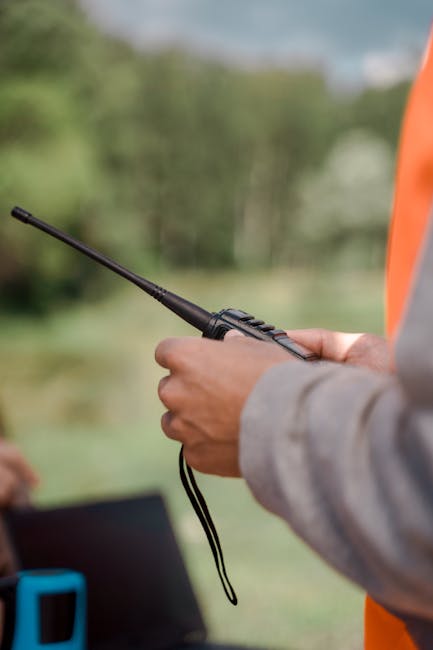
Two compact walkie talkies for camping beside a trail map and spare batteries on a picnic table

Walkie Talkies for Camping: How to Choose and Use Them

Camping radios are getting fresh attention in 2026 gear guides, but advertised mileage is only part of the story. Choose for terrain, battery needs, and local rules, then test your radios and agree on a simple contact plan.

12 min read

Camping Radios Are Back in the Gear-Guide Spotlight

Fresh buying guides are a useful starting point, but your campsite routine should decide what you buy.

GearLab’s guide, “The Best Walkie Talkies of 2026,” brings fresh attention to a familiar camping accessory. Before comparing its picks or any other rankings, ask a simpler question: who needs to talk to whom, and what will stand between them?

Walkie talkies for camping are useful when one person stays at camp while another collects supplies, when a group splits between nearby activities, or when vehicles need brief coordination on the way to a campground. Direct radio-to-radio communication does not need cellular service, but it does need compatible settings, charged batteries, and a clear enough radio path.

Radios add less value when everyone stays together or when your plan assumes reliable contact across several wooded ridges. A buying guide can help you shortlist models; it cannot guarantee coverage at your destination. The best setup is usually a few straightforward radios, tested over the distances you actually expect to cover.

    Match Your Radios to the Trip

    Buy for your usual outings, not the longest range printed on a package.

    Count independently moving people or subgroups first. A couple separating for campsite errands needs two radios. Six campers moving in three pairs can start with three, provided each pair stays together. One radio per person makes more sense when individuals will separate.

    For children carrying a radio, prioritize a clear push-to-talk button, a secure clip, and settings that can be locked. Practice a short exchange before leaving, and explain that having a radio does not change agreed exploring boundaries.

    • Campsite errands: Choose compact radios with simple controls and secure clips. Pack one per independently moving person or pair.
    • Trail outings: Favor manageable weight, protected controls, and enough battery capacity for a full day with reserve. Test the route where practical and agree on meeting points that do not depend on radio contact.
    • RV caravans: Start with one radio per vehicle. A passenger should handle messages when possible; drivers must follow local distracted-driving rules.
    • Mixed activities: Keep one radio with the person staying at camp and one with each departing subgroup, giving everyone a known base contact.

    Count radio positions, not just campers

    Four campers might need two, three, or four radios depending on how they split up. For a larger group, a labeled spare at camp can be worthwhile if you already own one.

    Choose a Legal Radio Service for Your Destination

    A radio that is legal at home is not automatically legal across a border.

    Choose the radio service before choosing the model. For casual camping, a locally approved license-exempt consumer service is often the simplest option. More power, programmable frequencies, and detachable antennas can bring additional licensing or equipment restrictions, not necessarily a better beginner experience.

    In the United States, compliant Family Radio Service, or FRS, radios do not require an individual FCC license. General Mobile Radio Service, or GMRS, generally requires an FCC individual license. That license covers the holder and qualifying immediate family members, not an entire group of unrelated friends. FRS and GMRS share some channels, but equipment requirements and operating permissions differ.

    PMR446 is a common license-exempt option in many European destinations when the equipment meets applicable requirements. Australia uses UHF CB under a class-license framework with operating conditions. Neither system is interchangeable with US FRS or GMRS simply because the handhelds look similar.

    Before departure, check the destination regulator’s current guidance on permitted equipment, frequencies, power, and who may transmit. Starting points include the FCC at fcc.gov, Ofcom at ofcom.org.uk, and ACMA at acma.gov.au. Check campground rules too, particularly quiet-hour expectations.

    • Confirm the exact radio service and model approval, not just a seller’s claim that a radio is license-free.
    • Check every country where you intend to use the radios on an international itinerary.
    • Avoid general-purpose programmable radios unless you understand the authorization and programming requirements.
    • Do not use marine, aviation, or other specialist channels for ordinary campsite chatter.
    • If your group mixes FRS and GMRS equipment, confirm both compatibility and each operator’s licensing requirements.

    Treat Advertised Range as a Best-Case Claim

    Trees, slopes, buildings, and vehicle bodies usually matter more than headline mileage.

    Long advertised ranges often reflect unusually favorable conditions, such as an open path between elevated locations. A radio that works clearly across an open campground may struggle over a much shorter distance with a hill between users.

    Dense vegetation, especially wet foliage, can weaken signals. Terrain can block them altogether. Hold a handheld upright and clear of your body rather than transmitting with it buried in a pack. Inside an RV, metalwork can further reduce performance.

    Think of range as a route-specific result, not a guaranteed circle around camp. If an exchange becomes scratchy, stop walking, hold the radio upright, and try a nearby open position if it remains within your planned route. Moving a short distance can help; extra power cannot reliably overcome a ridge.

    • Test from camp to likely destinations, such as the washhouse, parking area, and trail junction.
    • Include the least favorable part of the route, not just a clear path across the campsite.
    • Note where contact becomes unreliable and agree on a meeting point or return time beyond that area.
    • For vehicle groups, test at realistic spacing while parked. Clear reception between adjacent cars does not establish caravan coverage.
    “Plan around the places your radios work, not the miles on the box.”
    — CampMate planning rule

    Prioritize Batteries, Controls, and Weather Protection

    Useful everyday features deserve more attention than a long list of extra modes.

    Look for a prominent push-to-talk button, an understandable display, a keypad lock, and volume controls that do not invite accidental channel changes. A secure clip or short attachment loop keeps the radio accessible. Avoid dangling cords near moving equipment.

    Battery claims depend on how much time the radio spends transmitting, receiving, and waiting. Check the manufacturer’s test assumptions rather than treating the listed runtime as guaranteed. USB charging is convenient, but confirm the connector, whether charging happens directly or through a dock, and whether a specific rechargeable pack is required. Never try to recharge disposable batteries.

    An IP rating describes tested protection against dust and water. Read the model’s conditions, including whether charging-port covers must be closed. Splash resistance is not permission to leave a radio exposed through prolonged rain, and waterproof does not necessarily mean floating. Dry equipment as instructed before charging.

    Weather reception is separate from two-way communication. NOAA weather channels can be useful in covered areas of the United States, but a NOAA button is not a worldwide forecast service. Check coverage and whether alerts require a particular operating mode.

    • Two-radio weekend base kit: Pack 2 charged radios, 2 secure clips, and either compatible charging cables or a suitable two-radio dock. Include any required adapters.
    • Replaceable-battery option: Pack at least 1 complete spare set per radio for a short trip, then adjust for tested runtime. If each radio uses 3 AA cells, two spare sets require 6 cells. Keep them labeled, dry, and protected against short circuits.
    • Rechargeable option: A charged 10,000 mAh power bank can be a starting point for a two-radio weekend, not a guarantee. Check battery capacities and test the actual charging setup at home. Allow separately for phones and other devices.
    • Wet-weather module: Add a suitable protective pouch per radio if needed, plus a dry storage bag for spare batteries and cables. Test whether the controls remain usable through the pouch.
    • Cold-weather module: Keep spare batteries warm and dry, and expect reduced runtime. Charge only within the manufacturer’s permitted temperature range, especially with lithium-ion packs.
    • Hot or dusty-weather module: Store radios and batteries out of direct sun, keep ports covered, and remove loose grit before opening covers.

    Check the charging bottleneck

    Two radios and one single-slot dock may need sequential charging. Test the full arrangement at home, including cables, adapters, and your power bank, before relying on it at camp.

    Set Up and Test Every Radio Before Leaving

    A compatibility check and a written contact plan prevent most avoidable radio confusion.

    Do the first setup at home with every radio present. Different brands can work together when they use a compatible service, the same frequency, and matching signaling settings. Channel numbers alone do not establish compatibility across different services or programming schemes.

    Start with privacy codes turned off on all units. These settings, commonly CTCSS tones or DCS codes, filter which transmissions open your speaker. They do not encrypt conversations or reserve a channel. If you enable them later, compare the actual tone frequency or DCS value in the manuals because numbered code lists can differ between brands.

    Choose a primary channel and a backup that everyone can legally use. Listen at the destination before settling on the primary. Agree on exactly when and how the group will switch to the backup, so one person does not change channels while everyone else stays put.

    • Charge every radio, install batteries correctly, and label units by person, pair, or vehicle.
    • Make a two-way voice test between every unit and the camp radio, then repeat outdoors at a useful distance.
    • Use simple names such as Camp, Trail Pair, and Blue Van. Write down the primary channel, backup channel, and code setting.
    • Schedule useful check-ins, such as departure, arrival at a junction, and the start of the return journey. Constant chatter uses batteries and clutters the channel.
    • Agree on a missed-check-in routine: for example, retry after five minutes, use the backup only at the agreed time, and keep the prearranged meeting point and return time.
    • Lock settings if available, set a comfortable volume, and confirm that everyone can unlock and operate their radio.

    Give the shared kit an owner

    Assign one person to bring and test shared radios, and give the charging kit a named owner too. In CampMate, list radios, spare battery sets, and charging gear with quantities and owners so the less exciting essentials make it into the bag.

    Keep Radio Messages Short and Campsite-Friendly

    Clear exchanges work better for your group and everyone sharing the channel.

    Listen first, press push-to-talk, pause briefly, and speak normally. Release the button completely to hear the reply. Most consumer handhelds cannot receive while you are holding the transmit button.

    Name the person you want, identify yourself, and give one useful message: “Camp, this is Trail Pair. We’re at the signed junction and heading back. Please confirm.” A short acknowledgment beats repeating a long explanation.

    Shared channels are public spaces. Keep personal details off the air, avoid talking over others, and use a permitted alternative channel if yours is busy. Privacy codes can hide other conversations from your speaker, so use the monitor function, if available, to check activity before transmitting.

    At camp, lower the volume and disable unnecessary keypad beeps or call tones where possible. A compatible earpiece can reduce noise, but keep enough awareness to hear your surroundings. Voice-activated transmission can accidentally broadcast wind or nearby conversation, so push-to-talk is usually simpler for casual camping.

      Walkie Talkies for Camping FAQ

      Quick answers before you buy, pack, or hand out the radios.

      • Are walkie talkies better than phones for camping? They are useful for quick group messages without cellular service, provided everyone stays within radio range. Phones remain useful for maps, detailed messages, and calls where service exists. Treat radios as an additional tool, not a replacement for agreed meeting plans.
      • Do privacy codes make conversations private? No. They filter incoming audio rather than encrypting your voice. Other users on the same frequency can still hear you, and the channel remains shared.
      • Can different brands talk to each other? Often, if they use compatible services and matching frequency settings. Start with codes off, test both directions, and consult the manuals. Matching channel numbers across unrelated services prove nothing.
      • How many radios should a camping group bring? Bring one per independently moving person, subgroup, or vehicle. Two suit a pair splitting up; three may suit six campers moving in three pairs. A spare is optional for most small groups.
      • Will more power fix poor range? Sometimes it helps, but it does not reliably overcome terrain blocking the signal. Antenna design, location, and the path between users matter. Power must also stay within local rules.
      • Should I choose rechargeable or replaceable-battery radios? Rechargeable models suit trips with dependable charging. Replaceable batteries simplify stays without power if you carry enough correct spare sets. Some models support both, but confirm which batteries are permitted and which can be charged.
      • Do camping walkie talkies need a license? It depends on the service and destination. Compliant US FRS radios do not require an individual FCC license, while GMRS generally does. Check the destination regulator’s current rules before buying or transmitting.

      Choose a Simple Setup Your Group Will Use

      Legal equipment, realistic expectations, and a little practice matter more than flashy specifications.

      The best camping radio setup is not necessarily the one with the most channels or the largest range claim. It is the one that covers your actual routines, lasts between charging opportunities, and remains easy to operate with cold fingers or a busy packing schedule.

      Choose the service allowed at your destination, count your independently moving groups, and test every radio together. Pack a proven power setup, add forecast-specific protection, and agree on check-ins and meeting points. A few clear habits make a modest pair of radios more useful than complicated equipment nobody has practiced using.

        Continue the journey

        Keep Your Radio Kit Together

        Add radios, spare batteries, charging gear, and weather protection to your CampMate trip list, with quantities and a clear packing owner for each item.

        Related Articles

        Continue exploring camping tips and packing guides